
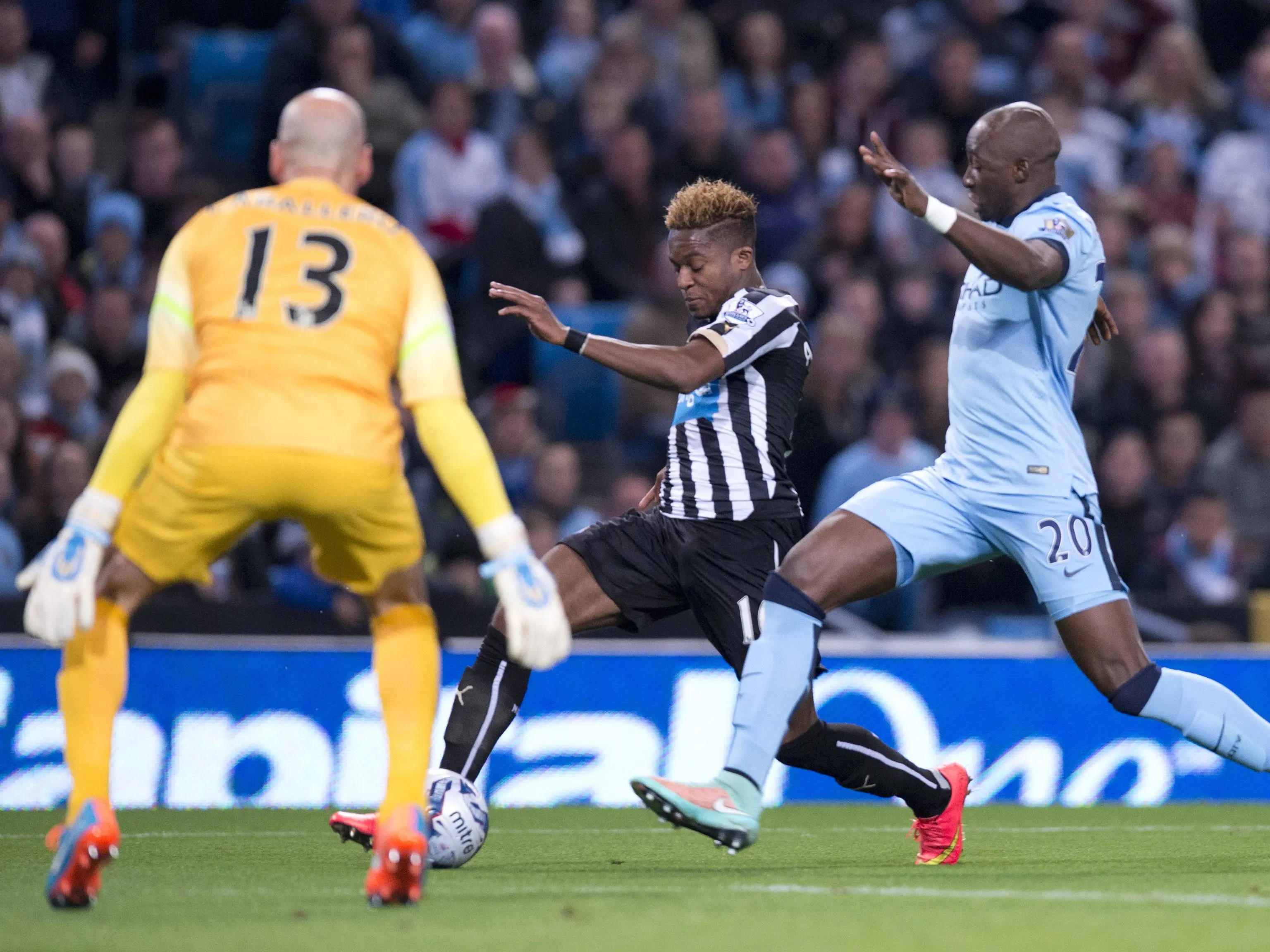
The night in question was Wednesday, 29th October 2014. Just as they will this Wednesday night, United travelled to the Etihad Stadium to face Manchester City in the League Cup. Back then it was the fourth round and Alan Pardew had made six changes from the previous weekend's Premier League game. Ryan Taylor began a game for the first time in more than two years, while Adam Armstrong, like Aarons, made just his second United start.
Six minutes in, Aarons seized an errant back pass and finished through Willy Caballero's legs. "Literally the whole stadium went quiet," Aarons recalls. "Apart from the Newcastle fans at the other end. I knew if I scored, I was going to run to Michael (Harding), the physio, who had worked with me for the previous six weeks. When you're injured, you feel a bit ignored. That is not me saying the manager didn't speak to me, but when you're not involved every day, you're not seeing the lads every day and you spend a lot of time with the physio."
Moussa Sissoko sealed a famous victory in the second half, with Aarons replaced later by fellow Academy graduate Sammy Ameobi. Paul Dummett also featured in what was a brilliant night for the club and, in particular, its youth set-up. It remains, at least until now, United's only victory in 22 attempts at the Etihad.
***
Aarons was just 16 when he swapped the South West for the North East. He had just been released by Bristol City, his home city club, having moved there aged five. He believes Newcastle spotted him during a trial at Birmingham City and, after just a day with Dave Watson's under-18s, United had seen plenty enough.
"Before I went to Newcastle, Leeds had offered me a professional contract," Aarons explains. "That made me less nervous I think, knowing that I had something secured. I went there with confidence. I'd trialled at a few other clubs and it hadn't gone so well, but I remember one academy manager said to me, 'remember, when you're on trial, you're on trial; you aren't one of the boys I've signed'. That stuck with me. It gave me the oomph to think, 'okay, I'm not here like the rest of the boys. I need to stand out'. I went with that mentality after that."
That summer Aarons moved into digs. Then moved again. And again. "I struggled to adapt," he admits. "I'm from a Jamaican family so had never lived in an English household. Dinner at 6pm?! I didn't know what tea or supper was!"
Many might mistakenly have little sympathy. The classic lines about getting to live out dreams are often chucked out as if to dismiss any notion of unhappiness. What is often forgotten, though, is that these are young humans, kids really, away from home. "I wanted to leave after six months," Aarons admits. "I'd never really done gym work before, and my body wasn't ready for it. I wasn't strong enough. I was squatting more than my body was ready to lift at the time. They were thinking I was strong, but my back wasn't thinking the same thing. I got a hairline fracture doing a squat. It was sore and I felt pain every time I ran."
Resultantly, Aarons dipped a toe in training here and there but was barely able to make an impression at his new workplace. His mind darkened and he began fixating on the fact he could have signed a professional contract at Elland Road, rather than the scholarship he had at United. In physio Sean Beech, Aarons found someone to help him escape solitude. "I was vulnerable with him and told him I thought I had to get out of this. He told me to hang in there - 'trust me, you'll be alright'. He played a big part in that moment."
Beech was rapidly proven right. A return to the pitch after six months out switched Aarons' mindset, with his attitude simply that: "the more you play, the less you think. I stopped thinking about how unsettled I was. I was just thinking about the games. It made it a lot easier to settle."
Soon Aarons was training with the first team and he remembers his first session well. It was snowing and he was in awe of Hatem Ben Arfa. "I was just a sponge, trying to soak in everything. What do they do? How do they walk? How do they jog in the warm-up? I was looking for minor things. I'm a bit of a football nerd."
By the second year of his scholarship, Aarons was training weekly with the seniors and appearing regularly in the under-21s. In March 2014, United's under-18s lost in the FA Youth Cup quarter-final to eventual champions Chelsea. Alan Pardew was present that night and on 1st April 2014 it was announced that Aarons had signed professional terms.
"As a kid, I used to look out my back window and see the stars and pray I'd become a professional footballer," Aarons says. "I'd think, 'I need to get out of this situation'. I was born in Jamaica, moved to Bristol. I grew up in a certain area, grew up with a certain amount of resources. It was very, very tough. I never really thought about the money - I wanted to accomplish something, to become something in my life."
Aarons came to United supporters' attention the following pre-season with a goal and assist against Schalke at the Veltins-Arena. "I just felt ready; do you know what I mean? A lot of players who do well in the youth team get fast-tracked. I felt like I was held back, which made me hungrier. I was ready mentally, ready physically. I'd trained the whole summer to make sure I was ready physically."
Extra work with players like Yannick Bolasie and Bobby De Cordova-Reid set a benchmark. Putting in extra hours over the holidays also represented a complete transformation in a kid who had previously treated football as something of a hobby.
He even moved in with Gael Bigirimana's family, spending hours on Killingworth Park running passing drills.
Aarons' Premier League debut came as a substitute in a 2-0 defeat to Manchester City in August 2014. "I wasn't nervous, but I was sat there shaking thinking, 'come on, come on, bring me on'. I was anxious to get out there. I spent as much time as possible warming up trying to catch the manager's eye!"
Aarons speaks highly of the welcome he received from senior players, the likes of Sissoko, Papiss Cissé and the late Cheick Tioté. Gabriel Obertan, too - albeit in a slightly different way. "He didn't help me directly," Aarons begins. "But he was so competitive and I think him looking at me as competition helped. He was thinking, 'you're not taking my place' or 'you think you're faster than me - let's race!'
Who was quicker? "I'd say he was… but not by much. And I was 18. If I hadn't had injuries I naturally would have gotten faster!"
Shortly before his goal at the Etihad, Aarons had scored at home in a 3-3 draw with Crystal Palace. By that point, expectations of Aarons were huge and with Ben Arfa having recently left for Hull City, a creativity hole needed plastering.
Sadly, in a 1-0 win over Liverpool on 1st November 2014, Aarons' hamstring popped and he missed six months, returning for a cameo in a defeat at QPR on the penultimate day of the season. By then, Pardew had long gone and John Carver was in charge.
The following season brought both calf and ankle injuries, but also a handful of appearances when fit, first under Steve McClaren and then Rafa Benítez. "I was going through a lot of what they would class now as mental health," he admits. "Imagine it's almost like you do well, you get a setback. You come back, you do well, you get a setback. You come back, you do well again, you get a setback. It was just too many highs and lows. I was struggling as an 18/19-year-old to deal with it.
"I started living alone at 18. I was having to go home and deal with all of that and then come back to training and deal with all of it by myself. I think I struggled massively."
Rather than seek help, Aarons did what too often feels natural in that situation - he pushed friends and family away. "I'd have no lights on in the house. I'd be in bed all day, waiting for the next day's training. Wake up, shower, see the physio and then come back and do the same again. It was a cycle. Looking back at it now, it was depression. I felt so lonely, so frustrated. I felt it must have been my fault - 'why does this keep happening to me?'"
Aarons' relationship with McClaren had been strong but it was mixed with his successor Benítez. He had filled in at left-back a few times but, in his own words, "had an absolute horror" in a 5-1 defeat at Stamford Bridge. But when first training under Benítez, he was also asked to play that position and played just one minute in a draw with Manchester City and 15 minutes in the 5-1 win over Tottenham on the last day of the 2016 season. United had by then been relegated.
"I had a year left on my contract. I was so frustrated with how it was going. I was definitely going to leave. My head was set on leaving. That's why I kind of over-celebrated. I know we're relegated, but I over-celebrated because that was, to me, my last game for Newcastle."
Benitez, though, was adamant that he wanted Aarons to stay and sign a new contract. "He said I was a big part of his plans but, for five months before that, he'd barely spoken to me. It was strange.
"Newcastle at that time was feeling like my club. I had a few offers and a few conversations with other clubs. But in the end, I thought, 'I really do love this place' and signed a five-year deal."
That was August 2016 and Aarons had just played 30 minutes as a substitute in a season opening defeat at Fulham. He made five appearances that August before breaking his metatarsal then, almost immediately on his return, rupturing his ACL and missing the entire season. He recalls that moment as particularly bleak. "In three months, I'd gone from signing a new five-year deal, breaking a bone in my foot and then, first session back, the day before my birthday, my season was finished.
"I tried to get in the bathtub with a fractured ACL - with no ACL basically - and I couldn't get in. I had a breakdown, started pulling the curtains off, smashing up the bathroom. I realised I was at breaking point there."
It was only then that he realised the need to surround himself with friends and family.
On returning to fitness, 2017/2018 brought fleeting appearances and on 31st January 2018 he joined Serie A club Hellas Verona on loan, re-uniting with one of Benítez's former coaches Fabio Pecchia.
When Benítez left Aarons out of United's 25-man Premier League squad for the 2018/19 season, he again departed temporarily, first to Slovan Liberec, then Sheffield Wednesday, Wycombe Wanderers and Motherwell. He eventually left United in January 2021 for Huddersfield and is now at National League Morecambe.
How does he reflect on his career, on what might have been after such a promising start? "I have to just be grateful that I even had these experiences because a lot of boys don't get to even do anything close to this," he explains with genuine humility.
He is also proud of how he grew from a 16-year-old living in a "bad area, getting involved in the wrong stuff, not going into school, probably around the wrong set of people at the time.
"I wasn't easily influenced. That was the worst thing about it. I was doing things I thought I were cool. My environment showed me they were cool and I wanted to be a cool person in my environment. And if you only know that environment, how can you know anything else?"
Various people helped him: McClaren, Steve Black, Rachel and David who he lived next door to in Great Park. However, for many reasons his course was never quite corrected. Leaving United was "difficult to accept because I felt like there were so many other factors other than it just being me.
"When I came to Newcastle, I was still learning how to navigate as a human. I'd only been around black Jamaican people. Moving to Newcastle, I didn't know how to speak to people. I didn't know how to socialise with anyone outside of where I was from.
"I struggled at Bristol City as well, because I didn't understand how football worked. There were times where I didn’t turn up for training for months, and I quit football a few times between the ages of 12 and 16.
"Learning all of that and then moving up, having so much success and, and like a bit of fame at the time, very soon, but no guidance, no good role models around me… my mum and dad weren't here. It was just me by myself trying to do it alone. You're going to make mistakes if you've got no guidance."
All of that could easily lead to resentment; instead, it simply resulted in love. To the United fans he would simply say "thank you for the moments that they shared with me. They made my time at the club special and I'm a Newcastle supporter now. It left an imprint on my heart forever. Newcastle is the fans. The identity of the club is the fans. It's the reason everyone talks about Newcastle."
Aarons has not returned since he left; he wants to rectify that soon.


