
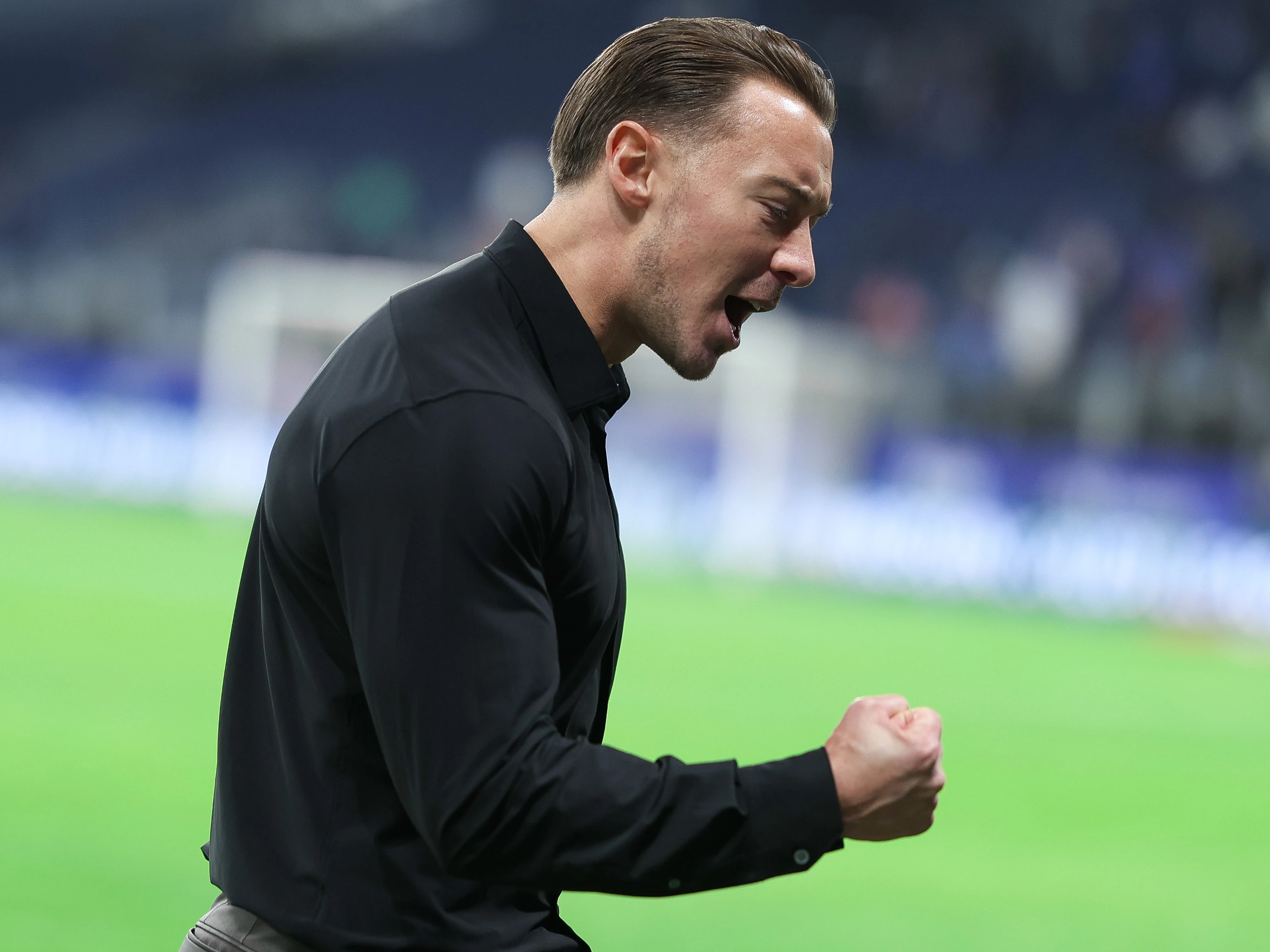
Before his stint in Jeddah, the 38-year-old made his name at Red Bull Salzburg, winning successive Austrian Bundesliga titles guiding the Die Roten Bullen to the Champions League knockout stage. Jaissle is known to have been influenced by his former manager at Hoffenheim, Ralf Rangnick, who also oversaw the development of the Red Bull football stable in the early 2010s.
That grounding shaped how his teams play - and below is a broad outline of what Magpies supporters can expect from their team under the new boss…
See Matthias Jaissle's First Game at St. James' Park - buy tickets here.
Pressing
Jaissle's teams press hard and high up the pitch, and usually attempt to win the ball back deep into opposition territory rather than dropping deep in defence of their own goal. They tend to chase the ball into the opposition half and try to force mistakes as close to the opposition goal as possible.
Newcastle supporters will recognise a lot of this from recent seasons, in which a pressing, intensive style helped a side led by Eddie Howe to win the Carabao Cup and qualify for the Champions League twice. As such, this style is unlikely to be much of a culture shock for those who watch the Magpies regularly.
Counter-pressing
This is perhaps the idea Jaissle is most closely associated with.
The moment his team loses the ball, players do not retreat. Instead, they swarm the area of possession straight away and try to win the ball back before the opponent can settle into a rhythm.
The aim is the quick recovery of the ball, ideally in dangerous positions, turning defence into attack in a heartbeat. It sits at the heart of how he wants to play but requires discipline, organisation and teamwork, as well as considerable athleticism and intensity.
"Very vertical"
Jaissle has previously described his approach as "very vertical". When his team wins the ball, the first thought is to go towards the opponent's goal quickly rather than pass sideways or slow things down.
His football has evolved over time, though, and there is flexibility. At Al-Ahli there were times when he exercised a greater level patience and control during the build-up phase of play, balancing that pragmatism with fast, direct intent the moment a chance to break opens up. He is likely to bring quick, forward-thinking football with him to Tyneside, but not recklessness.
Defensive organisation and structure
His teams defend from the front and hold a high defensive line, meaning the defenders push up the pitch to keep the team compact; again, this is to give them the chance to win the ball back sooner.
There is a degree of flexibility in his gameplan. A look at his last season with Al-Ahli shows that he often changed formation depending on the state of the game, using a 4-2-3-1 as a base when the scores were level, more compact shapes to protect a lead - and Jaissle would also deploy two strikers on occasion when chasing a goal.
That is a departure from his time at Salzburg between 2021 and 2023 when, in charge of a team who were dominant domestically, he tended to use one fixed shape, with a diamond midfield at the heart of a 4-4-2.
Ball progression
In plain terms, ball progression is simply how a team moves the ball from its own end up towards the attacking third.
Jaissle's Al-Ahli built patiently and short from the back, kept the ball central in the early stages, and tended to progress up the left flank.
To break into the final third they relied mainly on quick, short passes through central midfield, with the occasional long diagonal switches to the opposite flank as a release valve. They built calmly, before entering the final third sharply and with intent.
Intensity
Energy is a prerequisite for all of the above characteristics. Jaissle's football is high-tempo and demanding. Players are asked to press, cover ground and repeat those efforts for the full 90 minutes, so fitness and work rate are essential.
There are overlaps in terms of the high-pressing, high-line approach that the United squad he is inheriting are familiar already, so this may look more like an evolution in the team’s style than a reinvention. Energetic, athletic players are well suited to it - and there are plenty of players with those qualities already at St. James' Park.
Jaissle's approach in quotes
On flexibility, speaking to Sky Sports:
"It is not about formations that much. It is more how you want to play, how you want to attack, how you want to defend. If you understand that and the players understand that, tactically you are much more flexible and the formation is not that important."
On his influences as a coach, speaking to GiveMeSport:
"I have always tried to be authentic as a coach and find my own way. Of course, I have influences. Ralf Rangnick played a big part in developing my ideas because I played under him for most of my playing career. And in my youth, I had Thomas Tuchel, so I have followed his principles and career.
"Then there's Jurgen Klopp - I often looked at the transitions he put in place with Liverpool. In possession, I like how Pep Guardiola finds structure and balance. And there's a lot to take from Roberto De Zerbi's build-up as well. It's a constant learning process. And in the next few years, I'm sure there will be a different coach to draw inspiration from. It's not about copying other coaches, it's just about being inspired by them."
On the future, speaking to The Athletic:
"I just want to keep moving forward, keep being inspired by different things and to get to know new people. You need new input, because that's where progress comes from. Hopefully there are more trophies, but - more than that - hopefully there are more memories."


