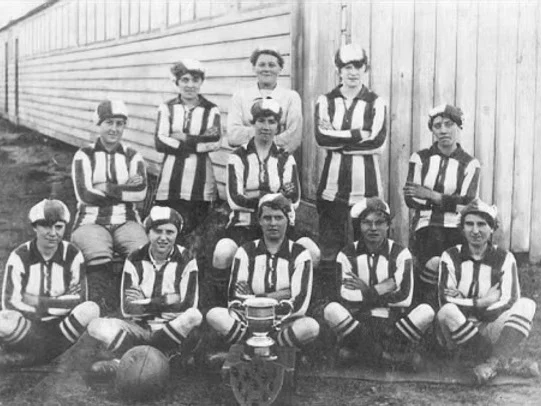
The Alfred Wood Munition Girls Challenge Cup was a knockout tournament for women who worked in munitions factories where bullets, guns, explosives and other military stocks were produced during the First World War. Taking place across the North East between 1917 and 1919, the story of what became known as the Munitionettes' Cup and those who played in it joins at the historical intersection of the region's industry, sport and women's roles - and Newcastle, and St. James' Park, have a hand in it.
It is detailed in part in Wor Bella, a stage play written by Ed Waugh focusing on the life of Bella Reay, a munitions worker and prolific goalscorer with Blyth Spartans Ladies. She netted a ridiculous 133 goals in just 30 games for the outstanding Spartans side and - spoiler alert - helped them win the cup in 1918. "It's Geordie history, North East history," says Waugh.
Women's football had a presence in the area before the 20th century. A pioneer going by the pseudonym Nettie Honeyball, a Victorian suffragist who led the staging of the first official match played by women in March 1895, brought the British Ladies' Football Club - the team she co-founded - to the region a year later. South Shields' Mowbray Park and Darlington's Feethams hosted friendlies, as did St. James' Park, where a crowd of 8,000 watched a seven-goal thriller.
The number of spectators hinted at a latent interest in the women's game but in the following decade there was little social basis upon which it could be supported. That changed in the First World War, when women began to fill roles vacated by men who were conscripted in 1916. By 1918, almost a million women were munitions workers, putting in long hours in dangerous conditions. Exposed to toxic chemicals like trinitrotoluene (TNT), they became known as canary girls, such was the yellow hue their skin would develop after handling explosive material.
To aid morale, health and productivity, team sports were encouraged. An official from the Ministry of Munitions in London told the Daily Mirror that "drill, music, dancing, games are what our munition girls need to make them efficient. After twelve hours' work and an hour's travel to and from home my girls at Woolwich were keen as mustard on gymnasium, swimming and football, and it made them the fine workers they are."
In the North East, a group of women tasked with loading and unloading shell cases and ammunition on the South Harbour in Blyth would kick a ball around in quieter moments. Their skills attracted the attention of the crew on a nearby Royal Navy ship, who passed on some advice and led to the formation of Blyth Spartans Ladies in 1917 - months before the feted Dick, Kerr Ladies, who once attracted a crowd of over 50,000, began blazing their own trail in Lancashire.
But Reay and her team came first. Reports from the time suggest the Munitionettes' Cup was open to any "Ladies' teams from Tyneside District drawn from any establishment or concern such as works, factories, mills, railways, tramways, collieries, shops etc". They would play each other for the prize of a solid silver trophy and ties would be allocated to charitable causes - in some cases, organisations helping injured servicemen - which would benefit from the gate receipts. "We had this organised competition, a head-to-head," Waugh adds. "That's what made women's football here different to anywhere else."
The draw on the Bigg Market handed Blyth a first round tie with Aviation Athletic, who were based at the Aerial Department at the Armstrong-Whitworth factory in Gosforth. A 5-1 victory at New Delaval set up a clash with North East Marine Engineering of Wallsend at St. James’ Park on 12th January 1918. Proceeds would go to the Joseph and Jane Cowen Training School in Benwell, which housed disabled soldiers and sailors.
It proved to be one of the more tempestuous encounters St. James' has hosted. Reay had scored four and Blyth were 5-0 up at the break. Another Reay effort after the restart led to the North East Marine Engineering team walking off the pitch, convinced it should have been chalked off for offside. Spectators invaded the pitch and chaos ensued. Amid fears of a riot, the Wallsend outfit were eventually persuaded to return to the field - but the referee refused to follow suit. Blyth prevailed once a replacement official was found, with Reay scoring six in their 7-1 win.
At Westoe in South Shields, Armstrong's Naval Yard of Walker were dispatched 3-0 in the third round, with Reay's brace helping to line up a return to Gallowgate for a last-four meeting with Armstrong-Whitworth's 57 Shell Shop. It finished 2-1, with Reay's winner in front of a crowd of 10,000 booking Blyth's place in the final.
"For the first time in history, working class women had money in their pockets," explains Waugh. "It gave them independence. They were getting their hair cut. They were going to pubs without chaperones - that's a massive thing. They were wearing trousers - again, unheard of." There was the occasional outcry over their matchday attire, in particular their shorts, which contravened social norms. Waugh points out that even the dresses worn by suffragettes were ankle-length. "These women who played were, in my eyes, revolutionary. Absolutely revolutionary."
Waugh, originally from South Shields, first came across the story that would inspire Wor Bella while researching another North East football trailblazer. An actor approached him to write a play about Mary Lyons, a munitions worker from Jarrow who was just 15 when scored on her England debut at St. James' in 1918. Around 20,000 people poured through the turnstiles to watch her make history against Scotland. She later worked for a window cleaner and then as a wardmaid in Homerton, Hackney, and was buried in an unmarked grave in Jarrow Cemetery. In 2025, 46 years after her death at the age of 77, she was honoured with a permanent headstone.
Like most of Waugh's work, Wor Bella is about ordinary people doing extraordinary things, "because I'm working class and I’m proud," he says. "I'm proud of where I come from, I'm proud of the people I've known. I've got best mates I've known since I was born. We stick together, you know, and it's a class thing for me.
"The problem is, working class history isn't written down. Working people don't think they're worldly and don't write their life stories. And yet they're the ones who create the wealth and keep the country going. Covid showed that. You don't need the wealthy, but you need the people at the bottom who are working."
St. James' Park hosted the Munitionettes' Cup final on 30th April 1918. Blyth's opponents were Bolckow, Vaughan & Co, of South Bank in Middlesbrough, who boasted the goalscoring prowess of future England representative international Winnie McKenna up front. Reay and the rest of the Blyth team were accompanied on the train to Newcastle by the band of the 3rd Battalion Northumberland Volunteers before over 15,000 piled in to watch the 0-0 stalemate, which was refereed by the former Newcastle United and West Bromwich Albion forward Bob Pailor.
The replay took place at Boro's Ayresome Park, where a crowd of 22,000 watched Reay's hat-trick, plus one from Lyons, help ease Blyth to a 5-0 triumph as they claimed the silverware. The Munitionettes' Cup had raised over £2,000. "They saved the war effort," says Waugh. "They worked 60 hours a week. It was so dangerous - you find out in the play how dangerous it was. It was hard, physical work, and then they went out and trained and played football. We owe it to these women, you know."
A journalistic grounding gave Waugh a nose for a story. At 33, he met Trevor Wood at Darlington College. Wood went on to write for the Evening Chronicle while Waugh freelanced, and around 24 years ago they began writing plays together. Among their first was Alf Ramsey Knew My Grandfather, the story of a team of miners from West Auckland who became the first world champions. They sold 4,000 tickets at the Gala Theatre in Durham before it transferred to Newcastle's Theatre Royal. "That was a dream for me," he reflects. "You're writing about something that you're totally absorbed in."
They wrote 11 plays together, including Dirty Dusting, a comedy about cleaners who started a telephone sex line, Maggie’s End, which begins with the death of Margaret Thatcher, and Good to Firm, which featured a love triangle set against a backdrop of horse racing. Local history pervades much of their work; A Funny Thing Happened on the Way to Durham is a sketch-based take on the story of the Lindisfarne Gospels and Amazing Grace pays tribute to Northumberland heroine Grace Darling.
After going solo, Waugh had his first big hit with Hadaway Harry, a play about the Dunston-born rower Harry Clasper, "the man the Blaydon Races was written for" who won the world rowing championships eight times. "A hundred and thirty thousand people turned up to line the rope when he died, and yet it was forgotten," says Waugh. "Alan Shearer wouldn't get that. And I love Alan."
He still finds sport to be an emotive platform. Carrying David, a one-man production based on Glenn McCrory's memoir and centring on the County Durham boxer's inspirational brother, "still brings me to tears when I watch it. I'm the conduit. That's all I am. But you've got to feel it. It's about heart."
Reay scored in the 1919 final too, for Palmer's of Jarrow and Hebburn in a 1-0 win over Brown's of West Hartlepool at St. James'. She was also involved in the final game between munitions workers, a 4-0 victory for Lyons' Newcastle Munitionettes over their Sunderland counterparts in front of 9,000, again at St. James’, in May 1919. This time, though, Reay was in the Sunderland line-up.
After successful runs in 2022 and 2024, Wor Bella is touring again in 2027. It rankles with Waugh that the role of the munitionettes in both the war effort and in women's football still isn’t adequately recognised. At the end of the war in 1918, munitions factories began to close as government contracts ended, with returning soldiers rejoining to the workforce. Munition workers lost their jobs and their football teams were disbanded. "They were just discarded," he says. "Some of them fought back, joined the unions and worked in other jobs.
"But they didn't even talk to their families. They were embarrassed that they'd played football. That was the way the press and the media and the governments of the time came down on them."
Was it embarrassment, or resentment at the lack of recognition? "Embarrassment," Waugh replies, citing interviews he conducted with grandchildren of munitions workers. "They weren't encouraged. It was frowned upon."
In December 1921, seven years before Equal Franchise Act of 1928 finally gave women the same voting rights as men, the Football Association banned the women's game from being played on FA-affiliated pitches, stating that "the game of football is quite unsuitable for females and ought not to be encouraged". The ban stood for almost 50 years, limiting women to games in public parks until an amendment in June 1971. "Fifty years is a lot to catch up on," he says. "But they're doing it. The last 20 years in particular has been incredible."
Waugh feels a sense of pride at the news that Blyth Spartans Women have reformed after 16 years away, attracting a gate of 350 to Croft Park for their return in the Adobe Women's FA Cup third qualifying round earlier this month. But they, like Newcastle United Women and the rest of the region's women’s teams, stand on the shoulders of Reay and her fellow munitionettes.
"I just get so annoyed. There's not one memorial to them. Not one," he adds. "It's women's rights. A hundred-odd years later, women are still getting less pay. Things have improved, obviously, but it's about women's rights and there's still a battle there. My wife says I'm a feminist, and I am, because I want equality. I want equality. To me, that's what it's about.
"This is about women who saved the war effort, who've been forgotten. It's a crime that they've been forgotten about after what they did."
Wor Bella is touring the North East and Cumbria in March 2027. For more information or to purchase tickets, visit worbella.co.uk