
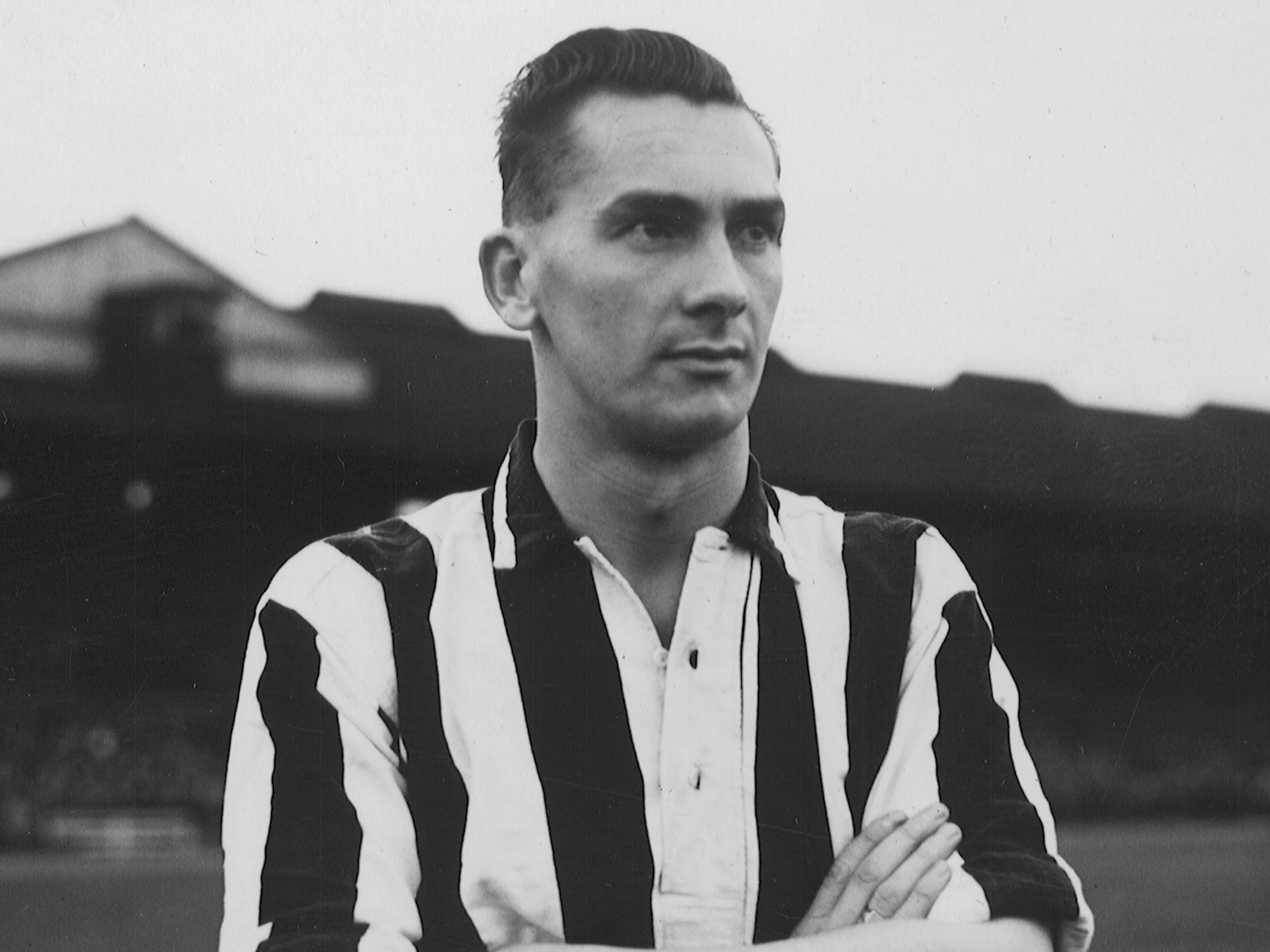
"From my bedroom you could see the pityard and the shaft leading down to the coalface," Milburn recollected. "It was a familiar view in the North East in the mid-Twenties and one which drew most of the lads like a magnet. The money to be made down the pit - and the beer it could buy - spoilt many a promising footballing career." Mercifully for us all, Milburn's wouldn’t be one of those.
Ashington's affiliation with coal goes back a long, long way - as far back as the prehistoric Carboniferous period, when vast tropical swamp forests covered the area. Over a gigantic period of time, layer after layer of dead plants and trees were buried beneath mud and other sediments, turning into peat as pressure and heat built up and, eventually, coal. The shallower seams below present-day Ashington were being exploited as early as the 13th century, before steam power and the Industrial Revolution came along and changed the face of the mining industry forever. Ashington remained little more than a hamlet until the 1840s, when the wealthy Duke of Portland started developing workers' housing to attract miners to the area. In 1867, the Bothal pit was sunk - marking the creation of the Ashington Colliery.
A major corporate operation called the Ashington Coal Company soon came along. So too did further pits and further terraced streets. In the 50 years between 1851 and 1901, Ashington's population swelled from just 350 to a whopping 14,000. In the process, it would become known as "the biggest mining village in the world". By the early 1920s, nearly 5,500 people worked at the Ashington Colliery. Among them was Milburn's father, Alec.
A handy footballer himself, Milburn recalled that Alec "could have gone to Tottenham, but preferred to stay home and drink his ale". At the Ashington Colliery, he was known as one of the finest coal cutters around - a skill that would "probably have allowed the family to live a little more comfortably than many of the other folk in the town," according to Milburn's own son, Jack. In practice, Alec's job would have seen him deployed at the very point where coal was extracted from the seam. Historically the role involved swinging a pick axe to undercut the coal, though by the 1920s, the operation was becoming increasingly mechanised. For Alec, the more coal he produced, the more money he earned.
Milburn - a hefty 14 pounds at birth - showed plenty of sporting promise early on, and was quick to determine that he had little desire to follow his father's lead and head down the mine. "In reality, he much more than anything wanted a life above ground in the fresh air, and also felt the urge to travel and spread his wings, praying one day he'd realise his boyhood dream of becoming a professional footballer," said Jack. "He and one or two of his pals considered themselves the 'revolutionaries' of their day by declaring their disinterest in going down the mine."
At the age of 14, Milburn left school - Hirst East Boys' - and took a job as a pantry boy at a country estate in Dorking, in Surrey. He lasted just four days, the North East’s boomerang effect in full force. "I saw a football match taking place outside the estate and I started to cry," Milburn recalled. "That's what I was missing most." After returning home, he jumped straight back into the local football scene and started working at a general dealer's shop, filling bags of flour and sugar and stacking shelves. In 1939, he tried to join the Royal Navy but, infamously, he was rejected for being an inch too short. He ended up joining the Air Training Corps instead.
As the Second World War broke out, coal mining was designated as a reserved occupation in Britain and Milburn, with Alec's help, was offered an apprenticeship as a fitter at the Ashington Colliery. To begin with, though, he started working at the saddler's workshop, making kneepads and belts and oiling harnesses for the pit ponies who kept the colliery's transport system running. Given the size of the equine workforce - there were as many as 1,400 ponies deployed at the Ashington Colliery at one point - it was no insignificant task.
Milburn was still to turn 16 when he started his apprenticeship in earnest. A five-year programme, it was comprised of several half-year stints across various parts of the profession. "You had six months on the cutters, six months on general, six months in the loco shed, six months in the garage… you covered every sphere of engineering, really," Milburn recalled. Work would begin at 7am and finish at 4.15pm, with a 40-minute break from 11.50am to 12.30pm. Still donning their overalls and pit boots, Milburn and his fellow apprentices would hurry over to the nearby patch of green known as "the Rec" for a kickabout most lunchtimes.
At the time, Milburn was playing football for the ATC's side, while also embarking on a rigorous training regime four nights a week at the Rec and in the gym. Playing largely among friends, Milburn's performances over a prolonged period didn't go unnoticed, and in 1943, he was selected to play for Northumberland against Yorkshire at Gateshead’s Redheugh Park. Northumberland won 3-0, and a watching United director, Wilf Taylor, invited the whole squad to come along to St. James' Park to see the Magpies contest a wartime fixture against Darlington. An excited Milburn duly attended, visiting the ground for the first time, but found that he wasn’t hugely impressed by the standard on show. Indeed, on the bus home that day, he and pal Raymond Poxton came to a conclusion: "We can do better."
They wrote to the club to request a trial and, shortly before the 1943/44 season kicked off, they were given the chance to take part in a "United vs. The Rest" fixture at Gallowgate. Milburn scored twice and was asked to return the following week, though sadly Raymond didn’t make the grade. A remarkable six-goal showing in the second trial game resulted in a swift offer from director and stand-in manager Stan Seymour and the rest, in many ways, is history.
However, Milburn didn't become a professional footballer overnight. Instead, he signed part-time terms, earning 30 shillings (£1.50) per game, as well as travelling expenses. "As you’ll appreciate, this is purely a wartime measure and when League football is eventually resumed, you can leave the pit and become a full-time pro," Seymour told him. Milburn's debut came in a Wartime League fixture against Bradford City - whose side included a certain Joe Harvey. Weeknight training sessions at the Rec were replaced by weeknight training sessions at St. James' Park.
With his apprenticeship just about over, Milburn was transferred to the Woodhorn Colliery, at the northeast tip of Ashington. Taking its name from the nearby village, the Woodhorn site had opened in 1894, employing roughly 1,700 people at the time Milburn was based there. Nightshifts were the norm, and he'd often make his way to St. James' Park on a Saturday having just finished work at 8am. Famously, he'd catch the same bus to Newcastle as the supporters who were going to watch him. "Often they would yell at me to go to the front of the queue," he remembered. "But I waited my turn like the rest."
By the time competitive League football had returned, for season 1946/47, he’d moved on again, to the Hazlerigg Colliery - a short distance from the Woolsington Hall estate that'll soon house the Magpies' new training complex. There, his second-in-command was a certain Len Shackleton, with the two known to travel back and forth to United training sessions on an "old boneshaker" of a motorbike. The Magpies were challenging at the top end of the Second Division that term and, the following year, would secure top flight football for the first time since 1933/34, but still, Milburn continued to spend the majority of his working life underground. It wasn't until late 1948 that he headed down the mine for the final time, having been diagnosed with external otitis (or swimmer’s ear). For a period, though, he continued doing surface work; as mining remained a reserved occupation, he couldn't be released permanently. The same applied to many of his United colleagues, across various different trades.
Milburn's exploits over the following decade require little introduction here. There were goals aplenty and trophies, too, with many of his accomplishments remaining unmatched until very recently. His name isn't just synonymous with St. James' Park or Newcastle United, but the North East as a whole, his remarkable rise serving as a source of inspiration for those in black and white as much today - during a period of great change - as it has at any point since his final game for the club in 1957.
Milburn passed away in 1988 - the same year the Ashington Colliery closed its doors. Those at Woodhorn and Hazlerigg had already gone by then. But the stories of all three collieries, just like Milburn's own, continue to resonate well into the 21st century, helping to shape a whole region's understanding of itself.


